Ankle Exoskeleton
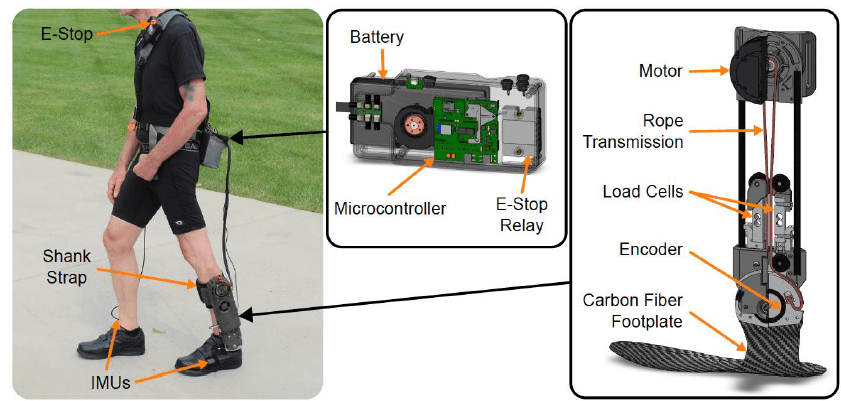
At the Harvard Biodesign Lab, designed, fabricated, and developed wearable ankle exoskeleton robots to assist gait. Created detailed CAD designs and fabricated multiple robot prototypes using SLS 3D printing, carbon fiber molding, and soldering new electronic components.
Conducted comprehensive data collection and analysis using MATLAB and Simulink, incorporating both on-body and bench-top testing to optimize performance through power flow analysis and iterative design methods. This work contributed to a paper featured at the IEEE International Conference on Robotics and Automation.
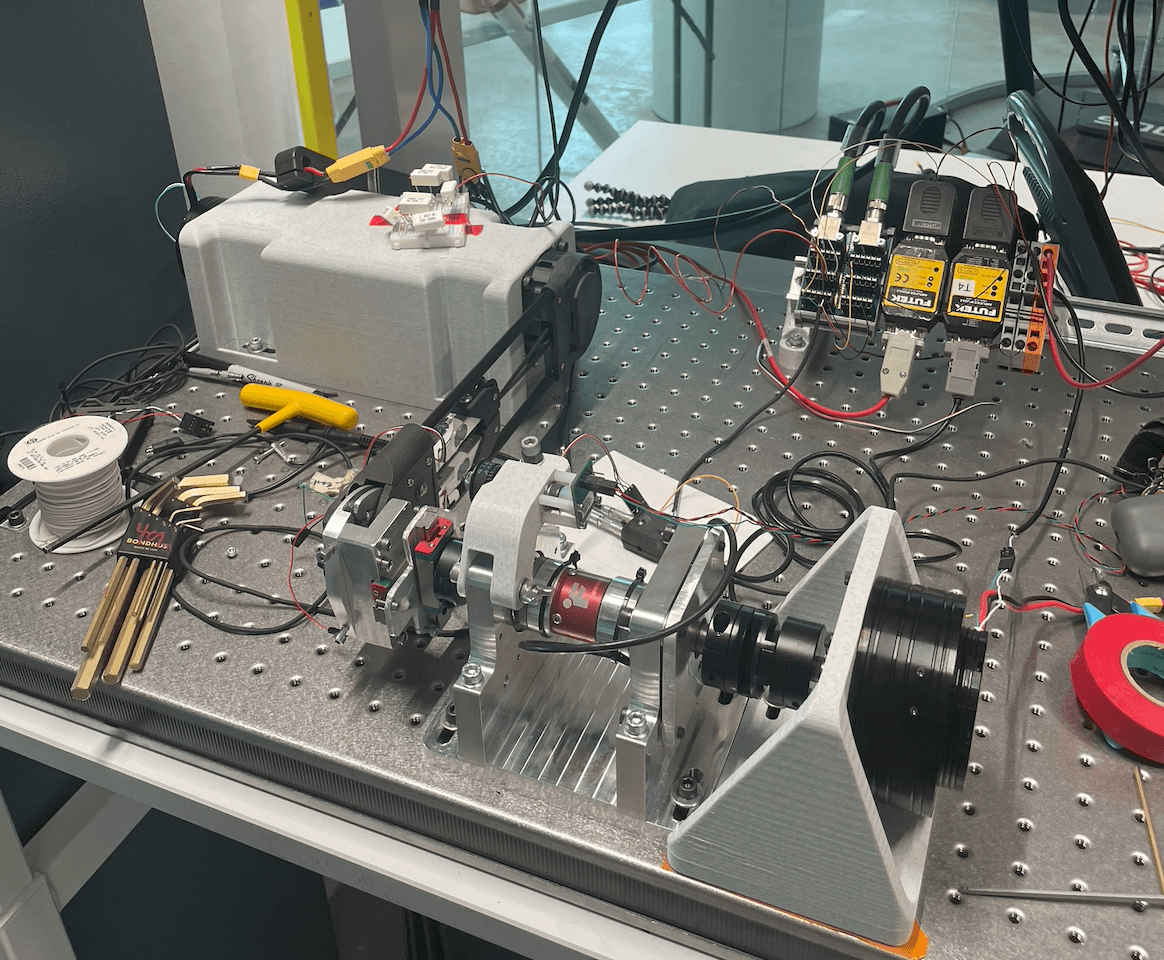
Benchtop testing
Bench characterization was used to quantify stiffness, transmission losses, hysteresis, and frequency response across assistance torque profiles. The setup consisted of a driving motor to set torque, a positional motor to set position, torque transducers at either end, and the internal force transducer in the robot to measure the internal torque. This data informed mechanical changes such as cable routing and the addition of bracing for torsional stiffness.
Data from these runs informed mechanical changes such as cable routing, the addition of bracing for torsional stiffness, and instigated an investigation into autotentioning methods for the transmission cable. It was also used for control tuning, enabling smoother assistance and better alignment between commanded and measured output. The controller was a PID with a feedforward term to account for the system's nonlinearity.
On body testing with device
On body testing was used to characterize device performance in real-world conditions, Performance in command following, and power transmission efficiency were collected for the IEEE paper on the device. This testing also led to the development of adjustable sheath sizes for the calf interface as well as multiple footplates for different users. Below is a video of me walking with the device.