Aidan Kimberley
Robotics Engineer — Controls • Computer Vision • Mechanical Design • R&D • Signal Processing

About
Robotics engineer with experience in wearable robotics R&D, mechanical design, and ML integration. Contributed to research presented at the IEEE International Conference on Robotics and Automation and led multiple technical projects from concept through execution. Seeking roles in mechatronics, mechanical design, and controls.
Experience

Harvard Biodesign Lab, Research Fellow — Conor Walsh, PhD
Boston, MA · April 2026 — Present
- Developing and testing a wearable exosuit to improve walking for people with parkinsons disease
- Developed a computer vision pipeline to temporally synchronize IMU and video data.
- Designing a new control scheme for the exosuit involving in-house trained ML models
- Collecting and analyzing data from human subject experiments.

Altec Research/Delsys, R&D Intern
Natick, MA · May 2025 — August 2025
- Validated a state-of-the-art computer vision software with an injury prevention application.
- Motion capture data collection, processing, and analysis.

Mass General Hospital IHP, Research Intern
Boston, MA · January 2024 — August 2024
- Debugged and optimized hardware/software for experimental protocols with TMS and direct current stimulators.
- Worked independently to solve lab technical issues.
- Performed data analysis using MATLAB to extract insights from noisy data.
Harvard Biodesign Lab, Undergraduate Research Fellow — Conor Walsh, PhD
Boston, MA · April 2022 — August 2023 (summer months)
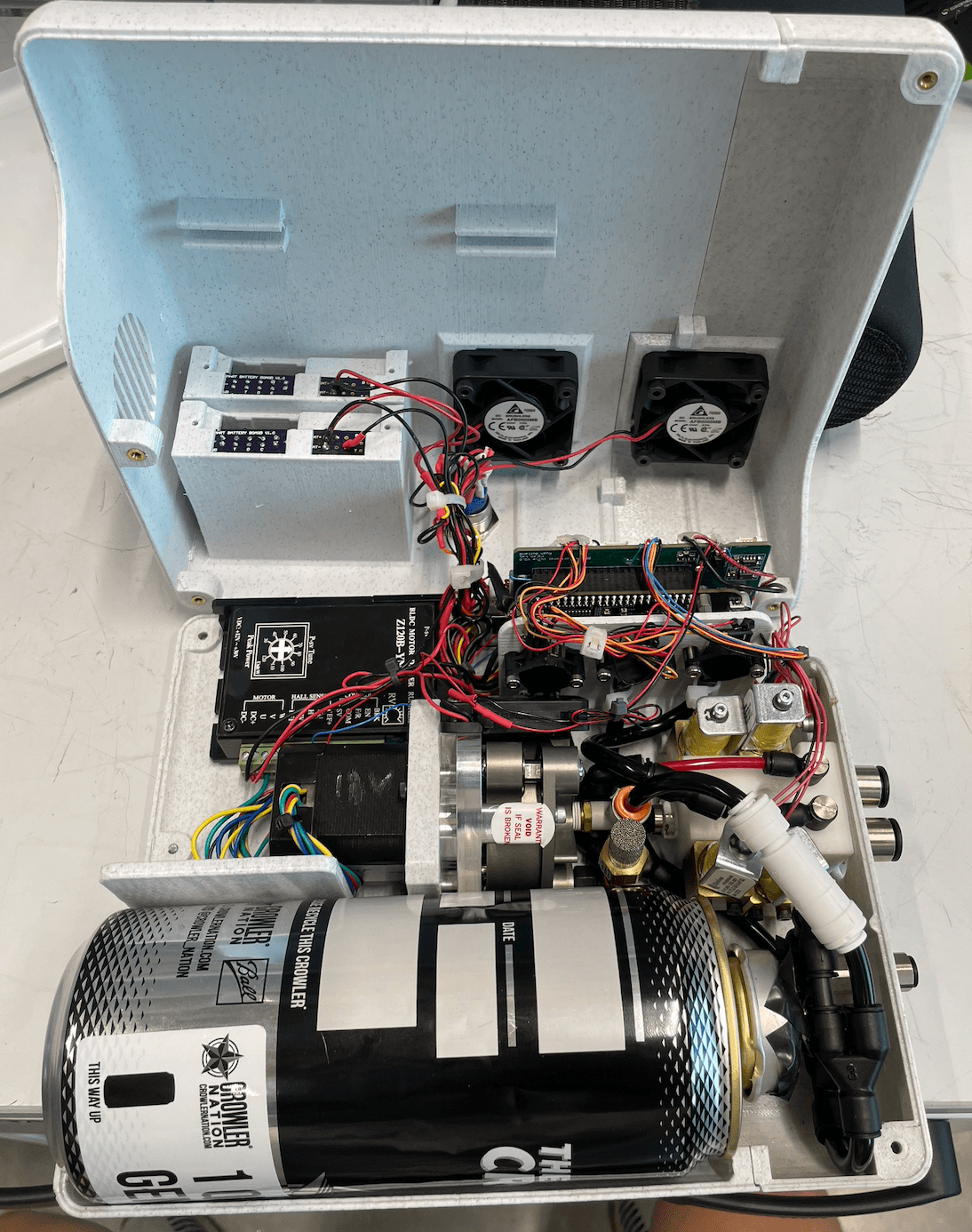
- Mechanical design, fabrication, and testing of wearable ankle exoskeleton robots and pneumatic robotic control boxes.
- Created designs in SOLIDWORKS; fabricated devices and control boxes using SLS/FDM 3D printing, electronics assembly, machining, and carbon fiber molding.
- Conducted benchtop testing with MATLAB/Simulink to characterize mechanical properties; iterated to improve mechanical advantage, frequency response, stiffness, yield strength, longevity, comfort, and adjustability.
- Ran on-body data collection using Qualisys to capture EMG, mocap, force plate, and internal sensing data.

McGill Formula Electric, Suspension Team Member
Montreal, CA · October 2022 — May 2023
- Used Siemens NX and finite element analysis to design components for a carbon fiber decoupled suspension system.

Cycle Loft Bike Shop, Service Technician
Burlington, MA · May 2021 — May 2022
- Built mountain, road, hybrid, and electric bikes from parts; assisted with repairs.
Skills
Design & Fabrication
- Manufacturing: CNC, carbon fiber molding, thermoforming, SLS/FDM 3D printing, MasterCAM
- CAD/FEA: SOLIDWORKS, Siemens NX, AutoCAD, Abaqus
- Electronics assembly: soldering and cable fabrication
Analytics & Programming
- Programming/Automation: Python, MATLAB, C, C++, Java, TypeScript
- Machine Learning: PyTorch, TensorFlow
- Simulation Tools: MATLAB, Simulink, Siemens NX
- Data processing/Statistical analysis: Python, Excel, MATLAB
- Motion capture: Vicon, Qualisys
Management & Communication
- Technical writing & reporting
- Project coordination & team collaboration
- Presentation development and delivery
- Leadership roles in research and engineering teams
Publications
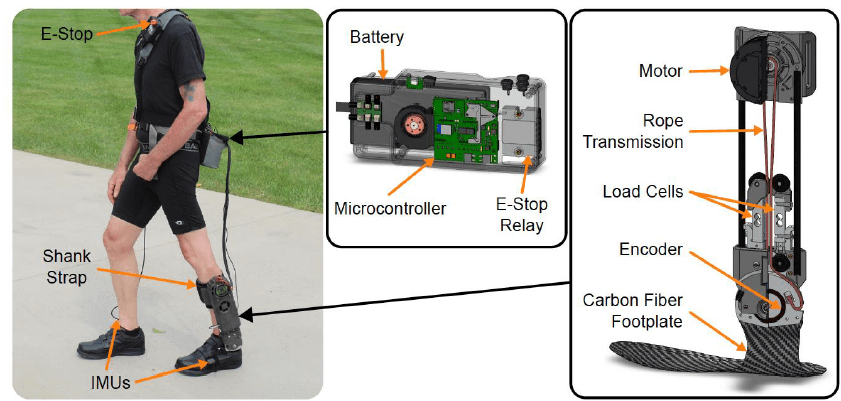
Design & Systematic Evaluation of Power Transmission Efficiency of an Ankle Exoskeleton for Walking Post-Stroke
IEEE International Conference on Robotics and Automation (ICRA) · May 13, 2024
Show abstract
Abstract—Community-based locomotor training post-stroke has shown improvements in independent ambulation by increasing dose, intensity, and specificity of walking practice. Robotic ankle exoskeletons hold the potential to facilitate continued rehabilitation at home, but understanding what aspects of the design are most relevant for successful translation to the community presents a challenge. Here, we design a portable rigid ankle exoskeleton to use as a research platform for investigating the effect of assistance on post-stroke gait during overground, community-based walking. We first test our device with stroke survivors and validate its potential for future community use. We then present a systematic method for quantifying power transmission losses at each transmission stage from the battery to the wearer, using data gathered from walking trials with healthy participants. Our evaluation method revealed inefficiencies in power transfer at the interface level, likely resulting from the compliance in the structural components of the system, which motivates future redesign considerations. Overall, our method provides a framework to identify and characterize the components that must be redesigned to lower exoskeleton weight and maximize performance.